
Understanding memory care cost in Michigan can be challenging because there is no single rate that applies to every resident or every senior living community. Costs can vary depending on the level of support a person needs, the type of accommodation selected, staffing, services included, and the way a community structures its pricing.
For families in Port Huron, Fort Gratiot, Marysville, and throughout St. Clair County, a useful approach is to understand what can affect memory care pricing, how memory care may differ from assisted living, and what questions to ask before choosing a community.
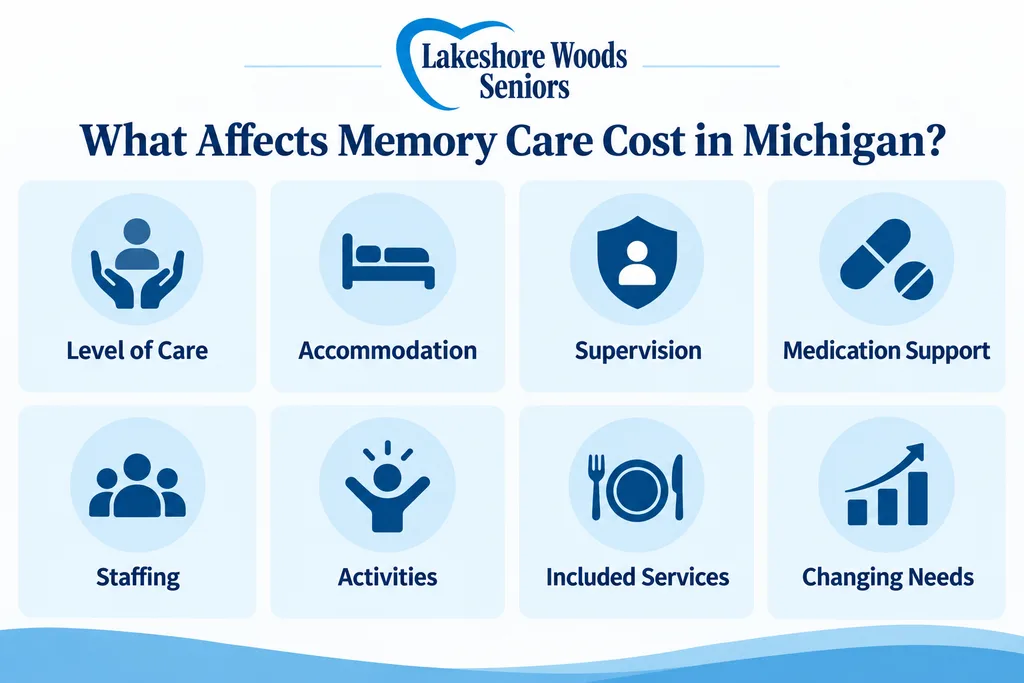
What Affects Memory Care Cost in Michigan?
There is no single memory care cost per month that applies throughout Michigan.
The amount a family may pay can depend on factors including:
- The resident’s level of care
- Type of accommodation
- Amount of daily supervision required
- Medication support
- Personal care needs
- Staffing
- Activities and programming
- Services included in the monthly rate
- Additional support that may be required over time
Because every resident has different needs, families should request a personalized written estimate from each community they are considering rather than relying only on a general online figure.
Families interested in Lakeshore Woods can also request current pricing and availability.
Memory Care vs Assisted Living Cost
One common question families ask is:
Why can memory care cost more than assisted living?
The difference is not simply about the type of apartment or room.
Memory care is designed around the needs of people living with Alzheimer’s disease, dementia, and other forms of memory loss. Depending on the community and the individual, care may involve additional supervision, dementia-focused staff training, structured routines, safety features, and programming adapted to cognitive needs.
Assisted living may be appropriate for someone who needs regular help with daily activities but does not need the same type or amount of cognitive support.
Because communities structure services and pricing differently, families should ask exactly which services are included in each quoted rate and which may involve an additional charge.
Families comparing care options may also find our guide to assisted living costs in Port Huron helpful.
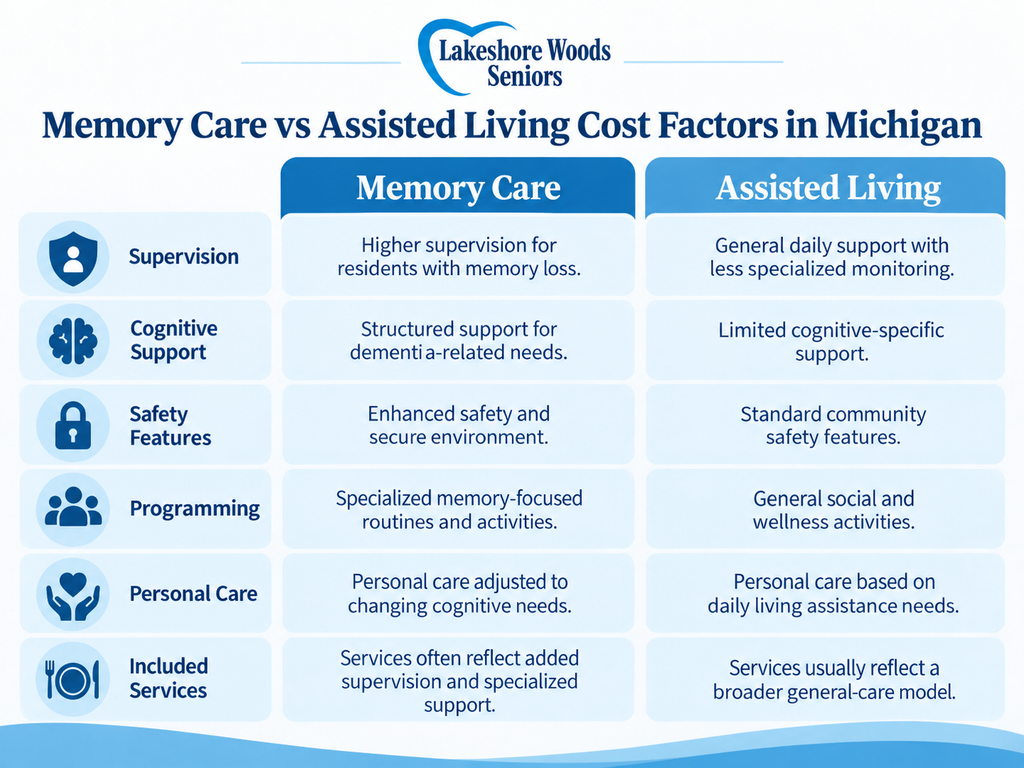
Why Can Memory Care Cost More Than Assisted Living?
Several features of memory care may differ from those offered in other senior living settings. Families should ask each community how these features relate to its pricing.
Staff Time and Supervision
A person living with memory loss may need reminders, redirection, assistance with personal care, medication support, help during meals, or supervision during different parts of the day.
The type and amount of support needed can vary considerably from one resident to another.
When comparing communities, families should ask:
- How is direct-care staffing organized during the day?
- What staffing is available overnight?
- Is nursing support available?
- Who is included when a staff-to-resident ratio is provided?
- How are changing care needs handled?
A staffing number alone does not explain how care is delivered. Families should also understand what assistance is available and how the community responds when a resident’s needs change.
Dementia-Focused Staff Training
Dementia care may involve training related to communication, person-centered care, activities of daily living, dementia-related behaviors, safety, and supportive environments. The Alzheimer’s Association Dementia Care Practice Recommendations address these areas in broader dementia-care guidance.
Families can ask communities what dementia-specific education or training staff receive, how often training is updated, and which team members participate.
Supportive and Secure Environments
Some people living with dementia can experience disorientation or difficulty recognizing potential safety risks.
Memory care settings may use features such as:
- Controlled entrances
- Secure areas
- Monitoring systems
- Clear layouts
- Familiar visual cues
- Spaces designed to support safer movement
Families should ask which safety features a particular community uses and whether they are appropriate for the individual’s needs.
Specialized Daily Programming
Activities for people living with memory loss may be adapted around cognitive ability, mobility, communication, interests, and familiar routines.
Programming may include:
- Music
- Games
- Movement
- Social activities
- Sensory experiences
- Familiar tasks
- Structured group activities
When touring a community, ask to see a current memory care activity calendar and find out how activities are adapted for different residents.
What Affects St. Clair County Memory Care Pricing?
Even within the same local area, two residents may receive different estimates.
Several factors can affect St. Clair County memory care pricing.
Level of Care Needed
An important factor is how much daily assistance a resident requires.
Someone who mainly needs reminders and supervision may have different care needs from someone who requires extensive assistance with:
- Bathing
- Dressing
- Mobility
- Toileting
- Incontinence care
- Medication support
- Eating and meals
- Daily supervision
Families should ask how the community assesses these needs and whether changes in support can affect the quoted rate.
Type of Accommodation
The type and size of the residence may also affect pricing.
Private accommodations, shared accommodations, studios, and larger living spaces may be priced differently.
Families should compare similar accommodation types when reviewing different communities.
Services Included in the Monthly Rate
Not every senior living community structures its pricing in the same way.
One community may include certain services in its monthly rate, while another may charge separately for them.
Depending on the community, families may need to ask about charges related to:
- Different levels of personal care
- Medication assistance
- Additional supervision
- Transportation
- Laundry or housekeeping
- Specialized services
- Community or move-in fees
Families should request a written breakdown and compare the expected total cost of care, not only an advertised or starting rate.
Michigan Licensing: What Families Should Know
Michigan does not use “assisted living” as one specific state licensing category.
The Michigan Department of Licensing and Regulatory Affairs (LARA) explains that the state does not license assisted or independent living facilities under those terms. Depending on the services and level of care provided, a Home for the Aged (HFA) or Adult Foster Care (AFC) license may be required.
Before selecting a residence, families should ask:
- What state license applies to this residence?
- What is the licensed name of the residence?
- Where can we review its current state licensing record?
- Are inspection or complaint investigation records available?
Families can review current information through Michigan LARA’s Adult Foster Care page and State Licensing of Homes for the Aged, Nursing Homes, and Hospital Long Term Care Units page. Families can also use the Verify License page to review licensing information.
Michigan LARA also provides information for families on its Placement of a Resident page.
What Should Families Ask Before Comparing Memory Care Costs?
Before choosing a community, request a written estimate based on the resident’s current needs.
Ask:
- What is included in the monthly rate?
- Which services cost extra?
- How are care levels determined?
- How often are care needs reassessed?
- Is medication assistance included?
- Are there one-time community or move-in fees?
- Can the rate change if additional assistance becomes necessary?
- Are activities, meals, housekeeping, and transportation included?
- How frequently are rates reviewed?
- How will the family be informed if care needs change?
Getting clear answers makes it easier to compare communities fairly.
Families who are still determining the right level of support can also explore the senior living options available at Lakeshore Woods.
How to Plan for Memory Care Costs
Because memory care needs vary from one resident to another, families should plan around the individual’s current support needs and obtain current information directly from the communities they are considering.
Before making a decision:
- Ask for a written pricing breakdown
- Confirm which services are included
- Ask about possible additional charges
- Understand how care levels are reassessed
- Ask how changes in care needs affect pricing
- Compare similar accommodations and care levels across communities
Families can request current pricing and availability from Lakeshore Woods to receive information based on their situation.
How Do Different Lakeshore Woods Living Options Compare?
Different people require different levels of support. Lakeshore Woods offers several senior living options on its Fort Gratiot campus.
Independent Living
Independent living may be appropriate for older adults who continue to manage their personal care independently but want fewer household responsibilities and convenient access to community amenities and services.
Assisted Living
Assisted living provides individualized help with daily activities based on a resident’s assessment and care plan.
It may be appropriate for someone who needs regular support with daily life but does not require the type of structured cognitive support associated with memory care.
Memory Care
Memory care is designed for residents living with memory loss who may benefit from additional structure, supervision, specialized support, and a supportive environment.
ReCODE+ For Facilities Program™
Lakeshore Woods is also home to the Michigan Cognitive Recovery Center, which offers the ReCODE+ For Facilities Program™ for appropriate candidates. A clinical assessment is required before enrollment.
The ReCODE+ For Facilities Program™ is different from standard residential memory care.
Families should request current eligibility, program term, and fee information directly.
Considering Memory Care at Lakeshore Woods
Lakeshore Woods Senior Living is located at 4851 Lakeshore Road in Fort Gratiot, Michigan, near Port Huron.
The community offers:
Families considering memory care can explore the Memory Care page to learn more about the environment, services, routines, and available support.
Because memory care needs are personal, families may find it helpful to visit the community, meet the team, ask questions, and discuss the individual’s current needs.
Frequently Asked Questions
How Much Does Memory Care Cost Per Month in Michigan?
There is no single memory care cost per month that applies to every community or resident in Michigan.
Pricing can vary according to factors such as accommodation, services, staffing structure, and the amount of daily assistance a resident needs.
Families should request current written pricing directly from the communities they are considering and confirm what is included in each quote.
How Much Does Memory Care Cost in St. Clair County?
Memory care pricing in St. Clair County and surrounding communities can vary according to the resident’s needs, accommodation, included services, and level of support.
Families should compare current written estimates from individual communities and make sure they are comparing similar services and accommodations.
Why Can Memory Care Cost More Than Assisted Living?
Memory care may involve different levels or types of supervision, dementia-focused staff training, structured routines, safety features, and specialized programming.
Exactly how those services affect pricing depends on the individual community and the resident’s needs. Families should review the written pricing structure instead of assuming that every memory care community prices services the same way.
Does Every Person With Dementia Need Memory Care?
No.
The appropriate level of support depends on the individual’s cognitive changes, safety needs, daily routines, ability to complete everyday activities, and the assistance available in their current setting.
Families should discuss care needs with appropriate healthcare professionals and prospective care providers when considering a change in living arrangement.
What Is Usually Included in Memory Care?
Services vary by community.
Depending on the residence and the individual’s care plan, services may include:
- Accommodation
- Meals
- Personal assistance
- Medication support
- Housekeeping
- Structured activities
- Supervision
- Access to safety-focused features or areas
Always ask a community exactly what is included in its quoted rate and what may involve an additional charge.
What Is the Difference Between Memory Care and ReCODE+?
Memory care is a residential care option for people who may need structured support because of memory loss.
MCRC offers a separate residential ReCODE+ For Facilities Program™ for appropriate candidates. A clinical assessment is required before enrollment.
Families should request current eligibility, program term, and fee information directly.
How Can We Get an Exact Memory Care Price?
The best way to obtain a current estimate is to discuss the resident’s needs with the community and request a written pricing breakdown.
Families should confirm what is included in the quoted rate, which services may cost extra, and how future changes in care needs could affect pricing.
Families can request pricing and availability from Lakeshore Woods.
Book a Tour
If you are comparing memory care options in St. Clair County, book a tour of Lakeshore Woods to see the community, meet the team, and ask questions about your family’s needs.
You can also request current pricing and availability to learn more about available options.
Sources
Michigan Department of Licensing and Regulatory Affairs (LARA): Adult Foster Care
Michigan Department of Licensing and Regulatory Affairs (LARA): Placement of a Resident
Michigan Department of Licensing and Regulatory Affairs (LARA): Verify License
Alzheimer’s Association: Dementia Care Practice Recommendations